
Most CEF analysis gives you one opinion. CEF Scout gives you two independent ones and tells you when they agree.
This post explains what’s under the hood: the two scoring systems, how they work, and what happens when they agree or disagree. If you want to understand why a fund gets a BUY or SELL rating in this newsletter, this is the reference.
The Timing Score: Systematic Execution
The Timing score is our proprietary system for identifying which CEFs are best suited for disciplined, mechanical trading.
It answers one question: “How well does this fund lend itself to systematic, rules-based investing?”
The score evaluates five areas:
Survivability: Can the fund absorb sustained buying during a drawdown without structural damage?
Volatility & Rebound Reliability: Does the price move enough to generate trading opportunities, and does it bounce back after dips?
Intrinsic Value Stability: Is the NAV floor solid, or is the fund in structural decline?
Cash Engine Quality: How sustainable is the distribution? A mid-strategy distribution cut forces painful adjustments.
Friction & Drag: Expense ratios, trading costs, and other headwinds that eat into returns.
The system then layers a Health filter on top; a set of deterioration flags that check for warning signs like declining UNII, inadequate distribution coverage, and destructive return of capital. A fund can score well on timing but still get downgraded if the fundamentals are deteriorating.
The result: a BUY / HOLD / WATCH / AVOID / SELL signal for every CEF.
The Academic Score: Evidence Based Control
The Academic score is our independent check. Every component comes directly from peer-reviewed research; no proprietary logic, no gut feel.
Think of it as the scientific control group. If the Timing system says BUY but the Academic model says AVOID, that disagreement is worth investigating before committing capital.
The components:
Discount Z-Score: How cheap is this fund relative to its own history? Extreme discounts tend to revert to the mean. Research by Thompson (1978), Pontiff (1995), and Kohl (2013) documented this pattern across decades of CEF data.
Distribution Sustainability: Is the yield real, or is the fund returning your own capital back to you? Pavloff (2013) showed that combining UNII trends with earned coverage ratios identifies the vast majority of bond CEF distribution cuts before they happen.
NAV Momentum: Is the underlying portfolio growing or shrinking? Bers & Madura (2000) found short-run NAV performance tends to persist, though the effect fades after about a year.
Liquidity: Smaller, thinly traded funds carry wider discounts as a structural feature, not necessarily an opportunity. Pontiff (1996) and Cherkes et al. (2009) documented this relationship.
One hard rule: any CEF less than 12 months from its IPO is automatically flagged AVOID. Research by Shao & Ritter (2018) found that CEF IPOs systematically underperform in their first year.
When Both Systems Agree: Consensus
The most interesting signals come when both systems point the same direction.
When Timing says BUY and Academic says BUY, that’s a fund with good trading mechanics, solid fundamentals, and academic evidence supporting the entry. We call this a Consensus signal.
When both say SELL, the message is even clearer: get out.
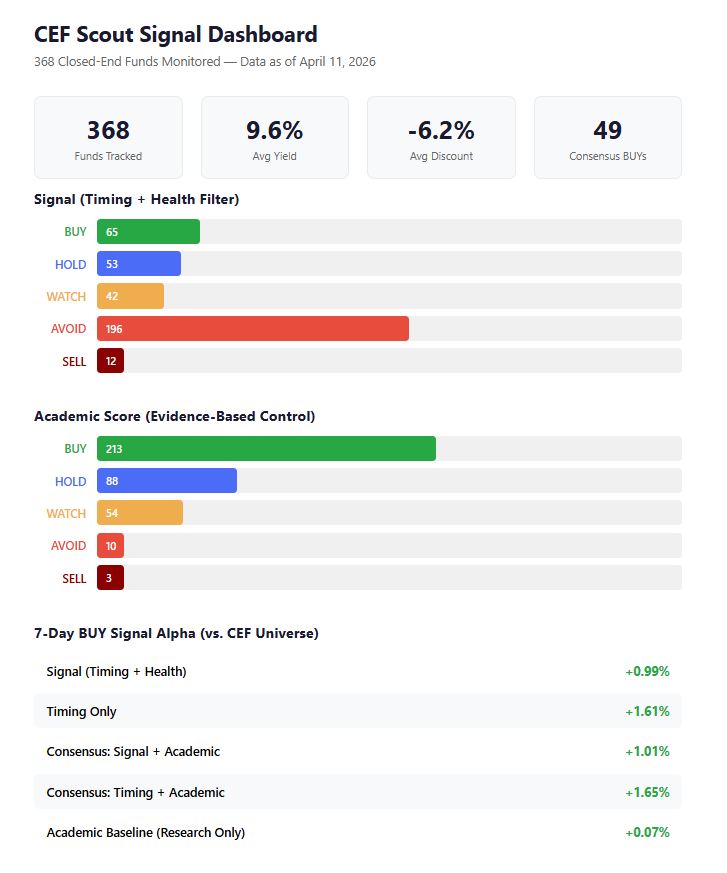
Right now, across 368 CEFs:
The Timing system shows 65 BUY and 12 SELL signals
The Academic model shows 213 BUY. It’s more permissive because it doesn’t filter for timing
49 funds have full Consensus BUY from both systems
All five signal systems generated positive alpha over the past 7 days vs. the CEF universe
Notice the difference: Academic sees many more BUYs because it only evaluates fundamentals. The Timing system is pickier because it also requires the fund to have the right trading characteristics and pass the health filter. That gap is the whole point, two independent perspectives.
What It Looks Like in Practice
Here’s the Explorer view, every fund scored across every system, updated daily:
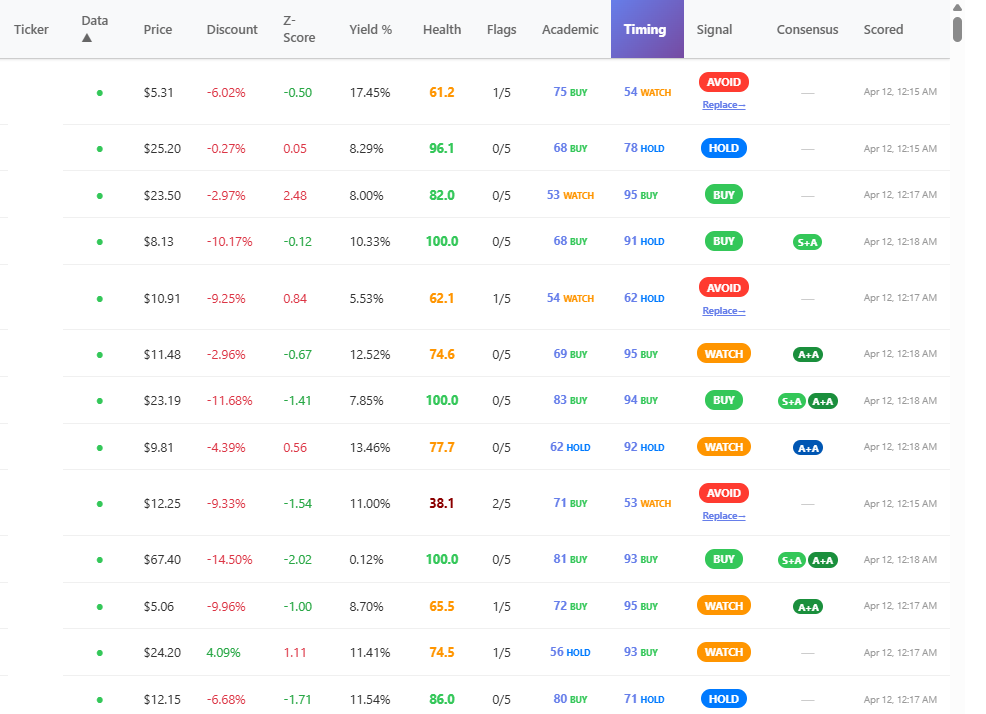
Each row shows the Timing score, Academic score, Health rating, deterioration flags, the final Signal, and any Consensus badges. You can see at a glance which funds both systems agree on.
Click any ticker and you get the full analysis:
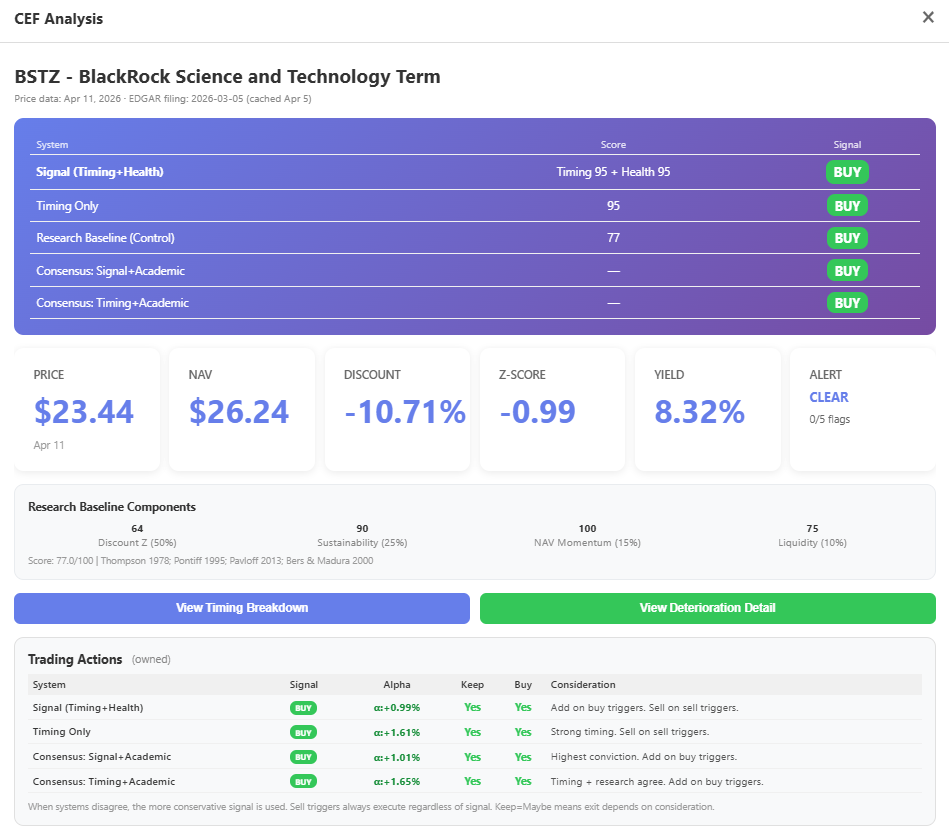
This is BSTZ (BlackRock Science and Technology Term), a fund where all five systems agree: BUY. I mentioned BSTZ on X a few days ago. Timing score of 95, Academic score of 77, Health at 95, zero deterioration flags, trading at a -10.71% discount with an 8.32% yield. The Trading Actions table shows exactly what to do for each system.
These are not BUY and HOLD recommendations. We readily admit we have no idea what is going to happen to the price of these funds in the future. But, our Timing system has a plan of what we are going to do if the price goes up, goes, down or goes nowhere. We also have a plan of when to exit and when to cut bait in case of a sustained loss. For the most part, we set our BUY and SELL orders in the market ahead of time as GTC (Good Til Cancelled) orders and then wait.
There are only 5 things a stock can do, we make money on 4 (80%) of those scenarios:
1. Go up a lot: We make money (less than buy and hold)
2. Go up a little: We make money (sometimes less, sometimes more than buy and hold)
3. Go nowhere: We make money (more than buy and hold)
4. Go down a little: We make money (more than buy and hold, which losses money)
5. Go down a lot: We lose money (but less than buy and hold).
ANYONE who tells you they know exactly what is going to happen to the price is either a liar, lucky, trading on inside information, or some combination of the three. The real edge in investing is having a system, staying consistent and taking every trade; especially at the times it’s hardest to do so.
What This Means For You
You don’t need to understand every component to use the signals. But knowing why a fund is rated the way it is helps you make better decisions, especially when a signal changes.
Every signal in this newsletter comes from these two systems. No opinions. No hunches. Just data and peer-reviewed evidence.
The first monthly Signal Scorecard is coming soon. A public, timestamped record of how each system’s signals performed against actual returns. Subscribe to follow along.
Past performance does not guarantee future results. This is not investment advice. CEF Scout provides educational analysis, investment decisions should be based on your individual situation, risk tolerance, and due diligence.